As yesterday we talked about the contional clauses, I thought to post something about it. I hope it will be useful!
Let's start with the ZERO CONDITIONAL: it is used to talk about facts, habits or actions that always have the same outcome (risultato). This include scientific facts and general statements (affermazioni).
If you heat water to 100 °C , it boils.
If it doesn't rain, the road doesn't get wet!
As you can notice, the tense (tempo verbale) in both parts of the sentence is the Simple Present.
And now the FIRST CONDITIONAL, that'sthe one we took a look at in our last class!
We use it to talk about possible situations and their consequences in the future...
A very confusing concept is when to use WILL and when to use BE GOING TO when we refer to the future!
There is a slight (lieve) difference between the two though (sebbene) in most cases they can be used interchangeably with no difference in meaning. Even if (anche se) you misuse (usare in modo sbagliato), a native speaker is going to understand you without any problems.
Here are two charts (tabelle) you can use to understand their differences:
Here a mind map with all the future tenses:
A very easy to understand video:
... and since I know how much you like songs:
❀❀❀❀❀❀❀❀❀❀❀❀❀❀❀❀❀❀❀❀❀❀❀❀❀❀❀❀❀❀❀❀❀
And last but not least.... here's a list of verbs followed by infinitive or gerund:
Comunicazione di servizio per la gita:
Ragazzi per favore oltre alle eventuali intolleranze mi fate scrivere due righe sul libretto delle comunicazioni dai vostri genitori se vi autorizzano o meno a ritornare da soli al rientro venerdì (si rientrerà verso le 21!). Per favore avvisate tutti gli altri che non riescono a leggere il blog!
We use a relative clause (proposizione relativa) to give extra information about the nouns (sostantivi/nomi) in the main clause (proposizione principale) , without starting a new sentence.
The relative clause goes immediately after the noun it relates to and it is introduced by a relative pronoun (pronome relativo).
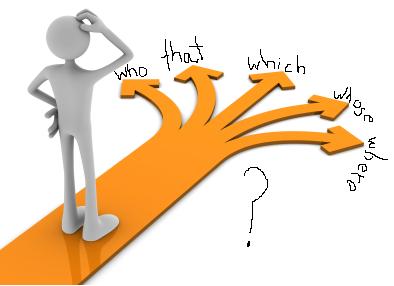
Relative pronouns are:
Examples:
The man WHO works at the Post Office is veery kind.
Tina has a bunch of flowers WHICH is friend bought.
The blue jacket THAT she is wearing belongs to her friend.
The man THAT lives upstairs is a doctor.
That is the house WHOSE owner is my uncle.
The hotel WHERE we slept was excellent.
That was the day WHEN my sister was born.
Tell me the reason WHY you are here!
Here's a map for you:
And here a couple of videos:
And now the best part of this post:
For our next lesson on Monday you have to:
study the rules of relative pronouns on your textbook (p. 89 D)
do p. 15 ex. 7 (libro) - 8 (quaderno)
do p. 92 ex 7 (l) - 8 (l)
write 10 sentences using the relatives pronouns and going to
Yesterday we talked about the use of "be going to" and the Present Continuous... and I know it was a little bit confusing for you! But don't worry! I found out (ho scoperto) that it's confusing for native English speakers too! =) I'll try to give you some hints (aiuto, suggerimento) in this post!
Let's start by saying that these two forms are both (entrambe) used to talk about future plans, but there are, however, some differences between them!
The present continuous is used when we say what (ciò che) we have planned or arranged (organizzato)to do at a specific time in the future. These are fixed plans with definite time and/or place.
Jill is starting university in September
Sally is meeting John at seven o'clock this evening in a restaurant downtown (in centro)
Do you remember its structure? If you don't... just take a look below!
____________________________________
We use "going to" to express the future when we intend to do something or we have decided to do something but did NOT ARRANGE it. It is just an INTENTION.
Mary: The windows are dirty
Suzie: Yes, I know. I'm going to clean them later
(Suzie has decided to clean them, but she hasn't arranged to clean them)
We can also use "Going to" to make predictions (previsioni).
Watch out! You're going to break the glass.
It's cloudy! I think it's going to rain
Take a look at the structure:
Maybe the following video can help you more! I think he's very clear in explaining... what do you think?