sabato 22 aprile 2017

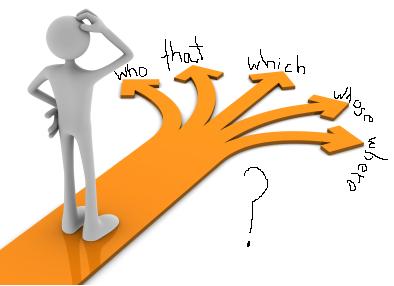
Relative pronouns and relative clauses


We use a relative clause (proposizione relativa) to give extra information about the nouns (sostantivi/nomi) in the main clause (proposizione principale) , without starting a new sentence.

The relative clause goes immediately after the noun it relates to and it is introduced by a relative pronoun (pronome relativo).


Relative pronouns are:


Examples:

The man WHO works at the Post Office is veery kind.
Tina has a bunch of flowers WHICH is friend bought.
The blue jacket THAT she is wearing belongs to her friend.
The man THAT lives upstairs is a doctor.
That is the house WHOSE owner is my uncle.
The hotel WHERE we slept was excellent.
That was the day WHEN my sister was born.
Tell me the reason WHY you are here! 

Here's a map for you:


And here a couple of videos:


And now the best part of this post:


For our next lesson on Monday you have to:
  • study the rules of relative pronouns on your textbook (p. 89 D)
  • do p. 15 ex. 7 (libro) - 8 (quaderno)
  • do p. 92 ex 7 (l) - 8 (l)
  • write 10 sentences using the relatives pronouns and going to
Have a nice weekend! =)


domenica 16 aprile 2017

Happy Easter

Even though I'm a little bit late... I wish you all a very Happy Easter!

sabato 8 aprile 2017

Let's talk about.... the future!


Yesterday we talked about the use of "be going to"  and the Present Continuous... and I know it was  a little bit confusing for you! But don't worry! I found out (ho scoperto) that it's confusing for native English speakers too! =) I'll try to give you some hints (aiuto, suggerimento) in this post!


Let's start by saying that these two forms are both (entrambe) used to talk about future plans, but there are, however, some differences between them!


The present continuous is used when we say what (ciò che) we have planned or arranged (organizzato) to do at a specific time in the future. These are fixed plans with definite time and/or place.

Jill is starting university in September
Sally is meeting John at seven o'clock this evening in a restaurant downtown (in centro)


Do you remember its structure? If you don't... just take a look below!


____________________________________


  • We use "going to" to express the future when we intend to do something or we have decided to do something but did NOT ARRANGE it. It is just an INTENTION.


Mary: The windows are dirty
Suzie: Yes, I know. I'm going to clean them later
 (Suzie has decided to clean them, but she hasn't arranged to clean them)


  • We can also use "Going to" to make predictions (previsioni).

Watch out! You're going to break the glass.
It's cloudy! I think it's going to rain


Take a look at the structure:


Maybe the following video can help you more! I think he's very clear in explaining... what do you think?


Have a nice weekend guys! 😎

martedì 28 marzo 2017

Let's have some laughs! =D

You just took a test, so I thought you would need a laugh!

At the beginning of this year, when we started this blog, Francesca told me she usually follows an English TV show, Jimmy Fallon (if I'm not wrong).. and I thought about another show I usually follow that always makes me laugh a lot.

The anchorwoman (presentatrice) of such TV show is Ellen Degeneres, one of America's most well-known  (conosciuta/ famosa) comedians. She also provided (dato) her voice to Dory, in the animated film "Finding Dory".


In the second video, she was with Kristen Bell, who gave her voice to princess Anna in Frozen!


Like Fallon, she sometimes interviews different famous people, but she does it in a funny way...


...or she makes parodies of song videos or films! Look here (try to watch them with subtitles)


And finally look at her playing Taboo with Katy Perry


I think she's great and hilarious! What do you think? Would you like to watch some more videos with her? Do you watch videos in English sometimes ? What kind of videos do you like to watch?


sabato 18 marzo 2017

St Paddy's Day

Did you know that yesterday it was Saint Patrick's Day?

St Patrick's Day occurs annually on March 17 in observance of the death of St Patrick, the patron saint of Ireland.

What began as a religious feast day in the 17th  century has evolved into a variety of festivals across the globe celebrating Irish culture with parades, special foods, music, dancing and a lot of green!

If you don't remember the history of Saint Patrick's Day... here is a funny video for you!


But St Patrick's Day is not celebrated just in Ireland: indeed people of Irish heritage celebrate it all over the world!


In Chicago they even colour the river in green!


Ehm... poor dog!

Can you think of a similar celebration here in Italy?

giovedì 16 marzo 2017

Transportation phrasal verbs

Here you are! I found it! 😎 
In this video, you can clearly understand the difference in the use of verbs such as "get on, get in..." and so on! Enjoy it and see you tomorrow...


venerdì 10 marzo 2017

Comparison

As I promised, I'm posting a couple of pictures about comparatives formation.

Here you can take a look at the structure (moreover you can also see how to form the superlative... that we're going to learn next week!):


Such as in the previous posts (come nei post precedenti), I'm posting some videos too!


When in the summary it says C+V+C... it stands for ( sta per) Consonant + Vowel + Consonant


In the next video, instead, you have some songs with examples of comparisons:


As in one of the songs we listened to...

.... don't give up with English: what doesn't kill you, makes you STRONGER!😉

Have a nice weekend!